
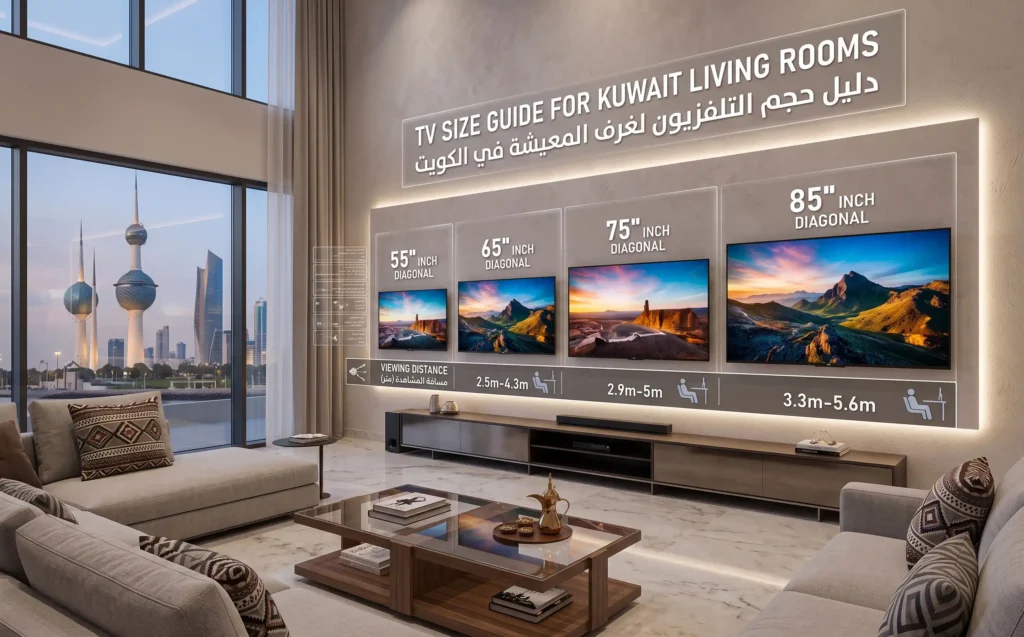
The “bigger is always better” advice breaks down fast in a typical Kuwait living room, where seating distance is often shorter than the showroom demos that sell you on a 75-inch screen. The right size is a function of how far you actually sit, not how impressive the screen looks in a large retail floor.
The viewing-distance math
As a practical rule for 4K content, divide your seating distance (in centimeters) by roughly 1.5 to get a reasonable screen size in inches — a seating distance of about 2.5 meters comfortably supports a 65-inch screen, while a 3–3.5 meter distance is where a 75-inch screen starts to make sense without the picture feeling oversized or requiring you to scan across it. Measure your actual seating distance in your own living room before you shop — showroom distances are almost always longer than the average Kuwait living room allows.
55″ vs. 65″ vs. 75″
55″ suits smaller living rooms and secondary rooms where seating is close — bedrooms, smaller majlis setups, or apartments. 65″ is the sweet spot for most standard Kuwait living rooms with typical sofa placement. 75″+ only makes sense in larger, open-plan living areas where seating is genuinely further back — otherwise you end up sitting too close for the size, which causes more eye strain than benefit.
Panel choice and GCC sunlight
Rooms with large windows and strong daytime sunlight — common in Kuwait villa and apartment living rooms — wash out lower-brightness panels badly. If your living room gets significant direct or indirect sunlight during the day, prioritize a panel with genuinely high peak brightness over one optimized purely for dark-room contrast; the dark-room advantages of some panel types are wasted if glare is washing out the image half the day anyway. If the room is heavily curtained or evening-focused, the calculation flips back toward contrast-optimized panels.
What to check before buying
- Measure your actual seating distance before you shop, not just the room’s overall size.
- Check the room’s daytime sunlight exposure and prioritize panel type accordingly.
- Confirm the model is authorized-channel stock — TV warranties are a real cost if a panel develops a fault, and grey-market units often complicate warranty claims through local service centers.
Check current pricing across sizes on the price tracker before deciding — the price-per-inch gap between size tiers shifts often enough that it’s worth checking rather than assuming last year’s pricing pattern still holds.
Refresh rate and gaming
If the TV will also be used for console or PC gaming, a higher native refresh rate and low input lag matter more than they do for pure streaming and broadcast viewing — a panel optimized purely for movie-watching contrast can feel noticeably laggy for fast-paced games. Check the input lag figures specifically for gaming mode, not just the marketing refresh-rate number.
Smart TV OS and Arabic-language support
Not every smart TV operating system handles Arabic-language menus, keyboards, and regional streaming apps equally well — this is worth checking in-store before buying, especially if Arabic-language content and interface are a daily-use priority rather than an occasional need.
Mounting vs. stand in a Kuwait apartment
Wall-mounting frees up console space and can improve the effective viewing angle in smaller rooms, but requires confirming wall material and mount weight rating before committing, especially in older buildings. A stand is simpler and fully reversible if you are renting or plan to move the TV between rooms later.
Frequently asked questions
Does a larger size always need a higher resolution?
At larger sizes and typical seating distances, resolution below 4K becomes noticeably softer — for 65 inches and above, 4K or higher is worth prioritizing over a lower-resolution panel at a similar price.
Should I buy the newest panel technology or last year’s model?
Last year’s model in the same size tier often drops meaningfully in price once a newer version launches, with a real-world viewing difference that is small for most living-room use. Check the price tracker for the actual gap before assuming newer is worth the premium.
How important is the warranty on a TV specifically?
More than most categories — panel faults are expensive to repair out of warranty, and grey-market units often complicate warranty claims through local authorized service centers. See the authorized vs grey market guide.